
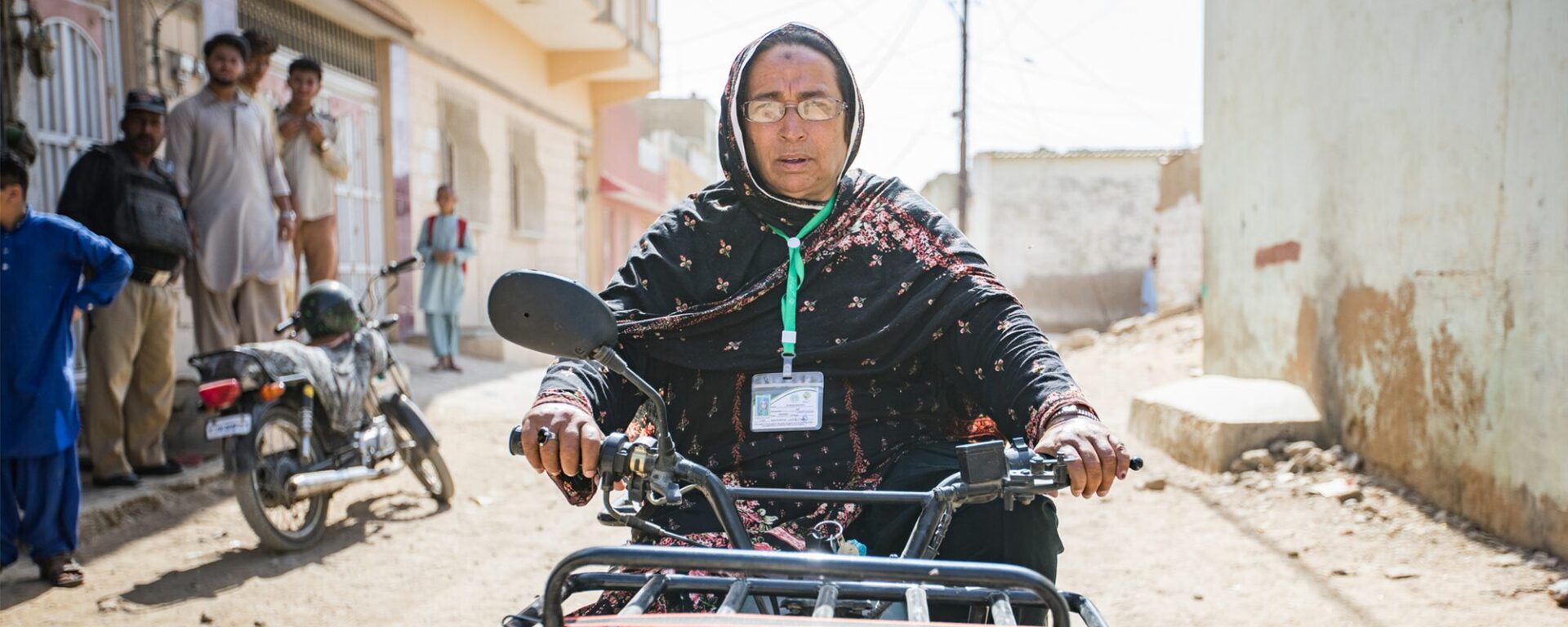
In the rough mountain terrain of southern Pakistan, each morning a woman climbs into a dune buggy with a cooler of vaccines and heads into some of the most inaccessible and war-torn areas of the country. Her job: finding the children no one else can reach.
The communities on her route are constantly on the move, made up of nomadic families living in informal settlements far from roads, clinics, or the infrastructure of a conventional health system. Many have never seen a vaccinator.
Reaching the Unreachable
Reaching them requires a different kind of thinking. These families don’t have addresses; they move with the seasons. House-to-house campaigns, the gold standard for vaccination, simply cannot find them. To address this challenge, The Global Polio Eradication Initiative (GPEI) started the Nomads Vaccination Initiative, which deploys teams using research and mapping to locate settlements across remote terrain and bring vaccines directly to them. Teams travel dozens of kilometers into areas without roads or reliable security, arriving, often for the very first time, with protection for their children. Since 2023, the initiative has delivered vaccines to over one million children who might have been missed otherwise.
Every year, GPEI vaccinates 370 million children. Since 1988, it has achieved something that once seemed biologically impossible: a 99.9 percent reduction in the number of children paralyzed by polio. Twenty million people are walking today because of those vaccinations. As of 2026, every country in the world has eliminated polio except two: Pakistan and Afghanistan.
The System Behind the Miracle
That progress is held together by laboratories, supply chain infrastructure that keeps vaccines usable from factory to tent, and frontline workers who navigate conflict, misinformation, and extreme weather to keep kids healthy. When Pakistan was hit by catastrophic floods in 2022, health workers waded through deep water to reach displaced families and still vaccinated nearly 32 million children.
Ending polio once seemed unachievable. In all human history, only one disease has been erased from the earth entirely — smallpox in 1980. But thanks to programs like GPEI and frontline health workers, we’re closer than ever to the finish line. Dune buggies are taking us the last mile.
A Legacy Built to Last
But this work won’t end when polio does. It’s about more than eliminating individual diseases. What started as a polio program has become a valuable public health asset that can be activated in all types of health emergencies. When Ebola broke out in West Africa a decade ago, it was the polio program’s emergency response network—trained workers, surveillance systems, and community relationships—that helped contain it. That same infrastructure mobilized rapidly when COVID-19 arrived, deploying polio workers across dozens of countries to share information and resources before most health systems found their footing. Today, as Ebola continues to resurface in parts of Africa, the GPEI network remains one of the fastest and most trusted first-responders.
GPEI demonstrates what durable philanthropic investment can build: essential, lifesaving capacity. The laboratory network built to detect polio now supports surveillance for measles, cholera, and emerging threats we haven’t yet named. Solar-powered infrastructure installed for vaccine delivery now anchors entire local health systems.
The woman in the dune buggy is a symbol of a vast, indispensable and sometimes unseen system that has eliminated a polio from nearly every corner of the earth, and that stands ready, every time the world needs it, to do more.
We know how to do this. We have the tools, the workers, and the infrastructure. What keeps us going is what got us here: the belief that the impossible is worth attempting and the collective will to prove it. Together we can end polio for good.