
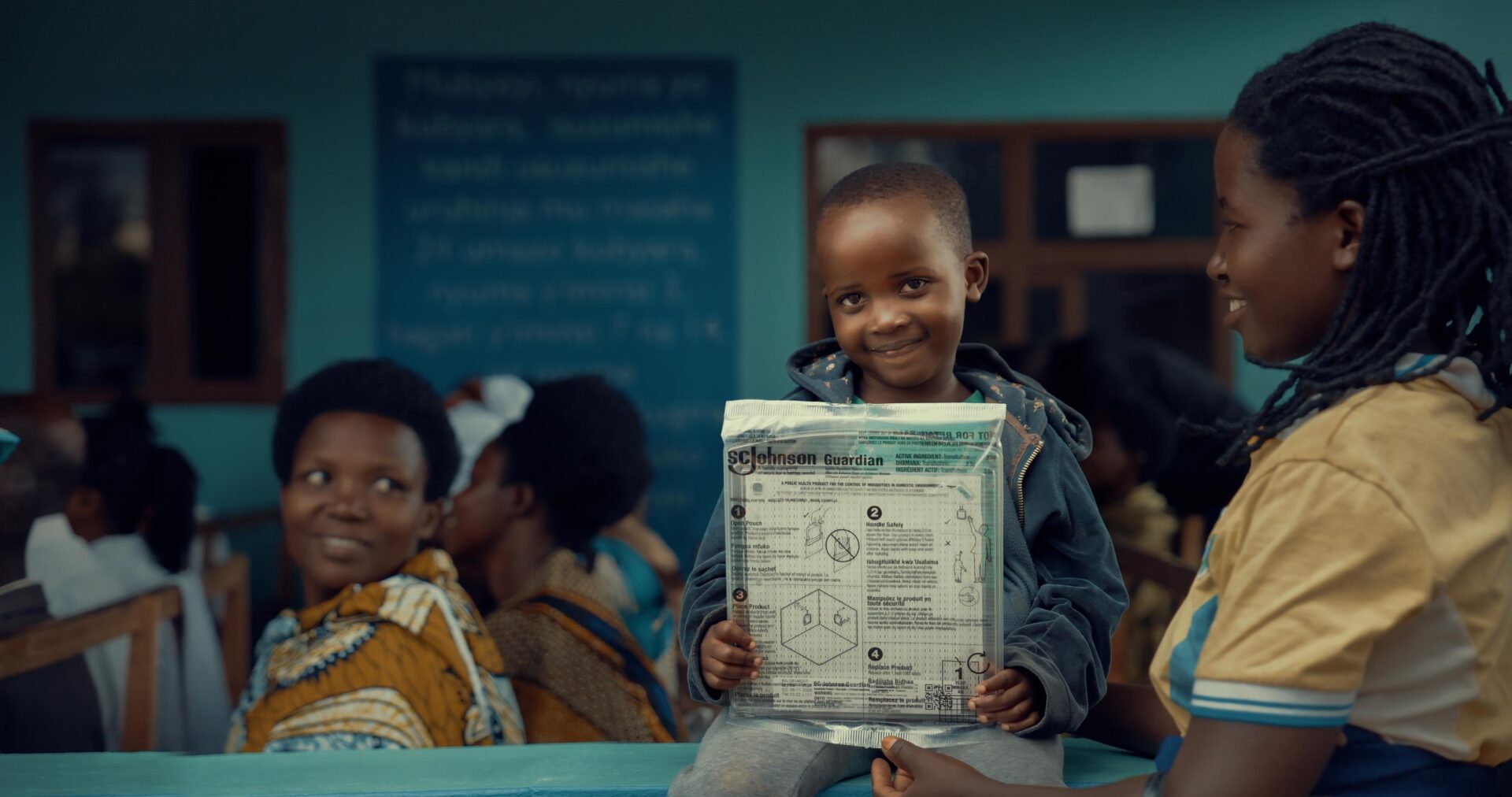
A single mosquito bite can change everything. In too many communities, malaria steals childhood by the minute.
Despite hard-won gains from insecticide-treated nets and indoor spraying, malaria still hits children hardest—most of those who die are under five, and in 2023 sub-Saharan Africa shouldered 94% of cases and 95% of deaths. As mosquitoes adapt to their environment and build resistance to insecticides, communities need new tools that similarly adapt to their daily lives.
The World Health Organization has urged countries and partners to diversify the malaria-control toolbox—to develop new, affordable, and complementary technologies that can reach households with little access to healthcare.
A simple, durable innovation
One of the most promising additions is the Guardian™ spatial repellent, developed by SC Johnson. Guardian is a small, durable device made from 3D mesh fabric and can withstand high temperatures and humidity—ideal for the harsh climates across Africa. Once opened and hung up indoors, it slowly releases a mosquito-repelling compound that keeps insects away for up to one year. While it’s not designed to replace bed nets, and can work in tandem with other interventions, it also performs as a standalone product or to provide continuous, passive protection for family members who may not always use nets consistently. In trials in Kenya, similar spatial repellents reduced new malaria infections by roughly one-third, showing how they can fill critical gaps in existing strategies.
At about $2.50 per unit, households could need a few devices for full protection—but that’s where partnerships are playing a role. Gates Philanthropy Partners is joining alongside the Gates Foundation and SC Johnson to support organizations already working within communities in Mali and Niger to introduce Guardian as an additional health intervention.
Leveraging REACH to go farther
To deliver this new tool to the children and families most at risk, Guardian will be piloted in Niger and Mali through the REACH platform—an established program that provides critical medicine twice a year to 17 million children across parts of the Sahel. These are among the world’s most remote communities, often more than five kilometers from the nearest clinic, where malaria, malnutrition, and diarrheal disease remain persistent threats.
Over the next year, Guardian will be added to the REACH platform as a new health tool, and local partners will work with SC Johnson to track how long it remains effective and its potential to reduce malaria burden. If this pilot program is successful, rapid scale-up across Niger and Mali is possible from a manufacturing plant in Kenya, which currently has capacity to produce 20 million units per year.
By working within trusted community networks and building on an existing successful health program, this public-private partnership offers a model for how new funding models and innovation can come together to protect children in the hardest-to-reach places—and bring us closer to ending malaria for good.